The Neuroscience of Flow State: Alpha, Gamma, and the Quiet Mind

Eric Blue
Founder & Lead Developer
When Mihaly Csikszentmihalyi began interviewing chess masters, surgeons, and rock climbers in the 1970s, he wasn’t trying to identify a brain state, he was trying to identify the conditions under which work felt intrinsically rewarding. What he found, and what later researchers like Steven Kotler have built on, is that “flow” is more than a description of subjective experience. It has a fingerprint you can measure on an EEG.
What Flow Looks Like in the Brain
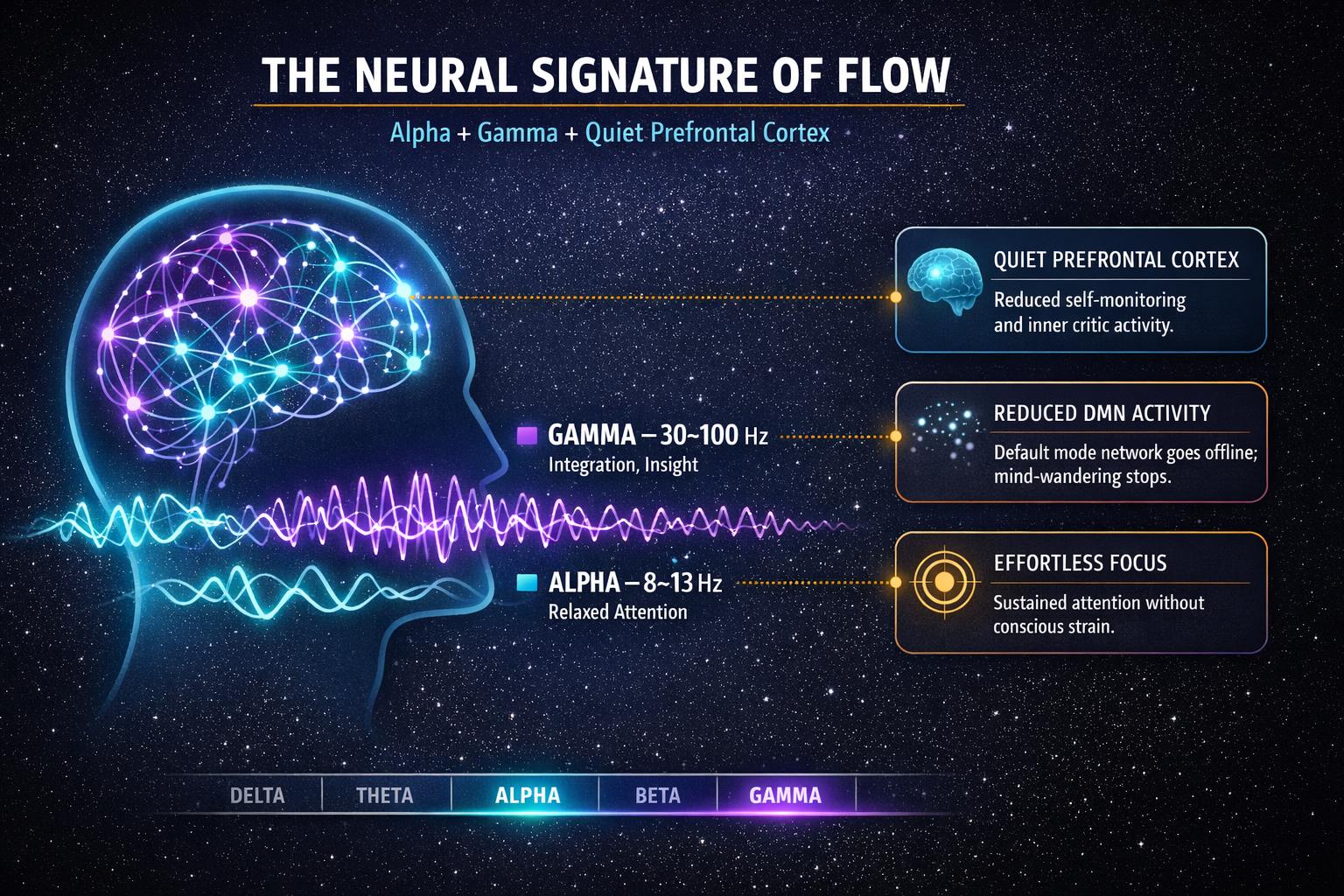
The neural signature of flow is unusual in that it’s not a single frequency, it’s a combination of states that don’t normally coexist comfortably:
- Elevated alpha (8–13 Hz), the relaxed-but-aware rhythm, reflecting reduced cortical chatter and decreased self-monitoring
- Bursts of gamma (30–100 Hz), high-frequency binding activity associated with integration, insight, and pattern recognition
- Decreased prefrontal beta, the analytical, planning frequency band quiets down, especially in regions associated with self-evaluation
- Reduced default mode network activity, the brain network responsible for mind-wandering and self-referential thought goes offline
This combination is sometimes described as transient hypofrontality, a temporary downregulation of the prefrontal cortex that allows other systems to run without the usual top-down second-guessing.
Why Alpha and Gamma Together?
The pairing is what makes flow distinctive. Alpha alone gives you relaxed attention. Gamma alone gives you high-energy cognitive processing. The two together produce something more interesting: effortless concentration on a complex task without the self-conscious overhead.
The “Aha” Brain
Mark Beeman’s research on insight problem-solving has shown that the moments preceding an “aha” experience are characterized by an increase in right-hemisphere alpha, the brain quieting down, followed immediately by a sharp gamma burst at the moment of insight. Flow can be thought of as a sustained version of that same pattern.
Flow Is a State, Not a Trait
One of the most useful findings from flow research is that the state is trainable. Some people seem to enter it more easily than others, but the conditions that produce it are well-defined:
- Clear goals. You know what success looks like at each moment.
- Immediate feedback. You can tell whether your action worked.
- Skill–challenge balance. The task is hard enough to demand your full attention, but not so hard that you flounder.
- Reduced distraction. Your attentional bandwidth is going to one thing.
When all four conditions are met, the brain tends to slide into flow on its own. The interesting question is whether you can pre-load the neural state to make the slide easier.
Where Binaural Beats Fit
Binaural beats can’t manufacture flow, that requires the right task and the right level of challenge. But they can help shape the brain’s starting conditions in flow’s direction. Two patterns from the entrainment literature are worth knowing:
- 10 Hz alpha entrainment before a deep-work session tends to increase reported “in the zone” experiences. The brain enters the work pre-warmed for relaxed focus.
- 40 Hz gamma entrainment has been studied for its role in cognitive integration and binding. Some users layer a brief gamma session at the start of a creative session, then drop into alpha-supportive audio for the duration.
A common pre-flow protocol:
| Phase | Duration | Frequency | Purpose |
|---|---|---|---|
| Warm-up | 5 min | 10 Hz alpha | Calm the nervous system, soften the inner critic |
| Priming | 3 min | 40 Hz gamma | Energize integration networks |
| Work | 25–90 min | 10–12 Hz alpha (low volume) | Sustain relaxed attention |
The audio doesn’t do the work for you, but it changes what your nervous system shows up to the work with.
Common Misconceptions
“Flow is just being focused.” Focus and flow share some neural features, but flow specifically requires the loss of self-monitoring and time distortion that come with reduced default mode activity. You can be focused and stressed; you can’t be in flow and stressed.
“Flow is rare.” It’s not, most people experience it weekly in some domain. What’s rare is being able to enter it intentionally on a given task.
“Flow requires extreme skill.” No. The skill–challenge balance condition just means the challenge has to be matched to your current ability. A beginner playing a beginner-level game can be in flow.
“Binaural beats can put you in flow.” No audio intervention can do that on its own. Flow requires task engagement. Entrainment is a supporting condition.
Closing Thought
The most useful framing I’ve found is that flow is the brain’s reward for matching attention to challenge. The neural signature, quiet prefrontal cortex, elevated alpha, gamma binding bursts, is the result, not the cause. Binaural beats, used thoughtfully, are one of several levers (alongside environment, sleep, and task design) for tilting the brain in flow’s direction. They don’t replace the work. They make the work easier to disappear into.