Gamma Waves, Insight, and Peak Cognitive Performance

Eric Blue
Founder & Lead Developer
When researchers want to understand how the brain binds information, how the visual cortex’s recognition of an object connects to the language area’s word for it, your memory of its smell, and your motor plan for picking it up, they look at gamma. It’s the band where integration happens. And it’s the one that’s been studied most intensely in the last twenty years for what it tells us about insight, expertise, and cognitive peak states.
What Gamma Actually Is
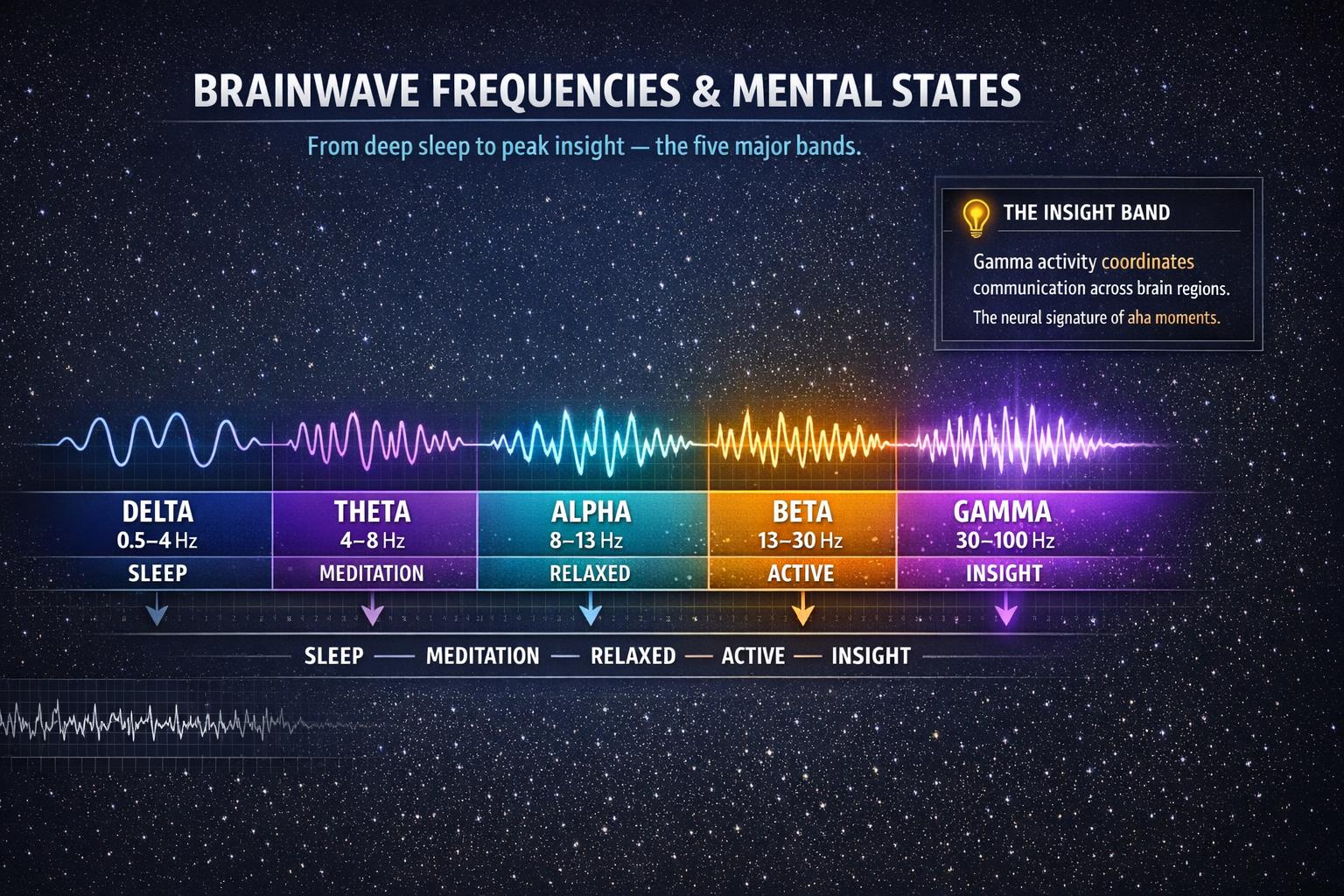
Gamma waves cycle at 30–100 Hz, by far the fastest of the major brainwave bands. They’re typically lower in amplitude than slower frequencies, which is why they were missed for decades by EEG analysis that focused on the larger, more obvious rhythms.
Gamma is most strongly associated with:
- Perceptual binding, the unification of separate features into a single perceived object
- Cross-region communication, coordinated activity across distant brain areas
- Working memory, holding multiple pieces of information online at once
- Conscious access, the moment information moves from sub-threshold processing into awareness
- Insight moments, the “aha” experience of a problem solution clicking into place
The Lutz Study and What It Showed
The most-cited piece of gamma-and-meditation research is Antoine Lutz and colleagues’ 2004 paper looking at long-term Tibetan Buddhist meditators. The headline finding: experienced practitioners showed gamma activity an order of magnitude higher than novice controls during compassion-focused meditation, with baseline gamma also elevated outside of practice.
The deeper finding, often missed in summaries, is that the gamma increase was phase-synchronized across distant brain regions. It wasn’t just more gamma, it was more coordinated gamma. That’s the kind of pattern associated with integrated, whole-brain functioning rather than localized activation.
A few caveats worth knowing: the meditators studied had a median of ~10,000 hours of practice, so the findings don’t generalize automatically to casual meditators. But they do establish a ceiling, what the brain is capable of with sustained training.
Gamma, Insight, and the “Aha” Moment
Mark Beeman and John Kounios have done some of the most elegant work on the neuroscience of insight. Their setup: have people solve word puzzles and report whether each solution arrived through analysis (working it out step by step) or insight (it just appeared). EEG and fMRI during the moments preceding each type of solution look very different.
Insight solutions are characterized by:
- A rise in right-hemisphere alpha in the seconds before the solution, the brain quiets down
- A sharp burst of gamma at the moment the solution appears, centered in the right anterior temporal lobe
- Reduced visual cortex activity just before insight, almost as if the brain is closing its external eyes to look inward
This pattern is reproducible enough that researchers can predict, with above-chance accuracy, which type of solution someone is about to produce.
Where Binaural Beats Fit
The honest answer is that gamma is harder to entrain than slower frequencies. The lower amplitude makes it less responsive to entrainment, and the more complex spatial pattern (cross-region synchrony) isn’t something a steady audio stimulus can directly produce.
That said, 40 Hz gamma entrainment has been studied for cognitive enhancement, and a few patterns are worth knowing:
- 40 Hz auditory entrainment has been shown to increase EEG gamma power, especially in midline regions
- Some studies have linked 40 Hz audio-visual stimulation to improvements on working memory and attention tasks
- A separate line of research (Tsai et al. and others) has explored 40 Hz stimulation in the context of memory and neurodegeneration, interesting work, still early
If you’re experimenting with gamma entrainment for cognitive performance:
| Use Case | Approach | Duration |
|---|---|---|
| Pre-creative session priming | 40 Hz binaural beats | 5–10 min |
| Working memory warmup | 40 Hz at moderate volume | 10–15 min |
| Insight problem-solving | Alternate 10 Hz alpha and 40 Hz gamma in 5-min blocks | 20 min |
| Long deep-work sessions | Skip gamma, use 10–12 Hz alpha instead | n/a |
A Word on Realistic Expectations
Gamma is exciting because it’s tied to so many high-end cognitive phenomena. But it’s also the frequency band most prone to overhype. A few honest caveats:
- Gamma entrainment doesn’t make you a Tibetan monk. Their gamma levels reflect a decade-plus of training, not the audio they’re listening to.
- You can’t think your way into more gamma. Gamma is a result of integrative cognitive work, not a cause. Entrainment may help; it doesn’t substitute.
- Effect sizes are modest. Gamma entrainment research shows real but small effects on cognition. Treat it as a small lever, not a magic bullet.
- Comfort matters. 40 Hz audio can feel buzzy or fatiguing for some people. If a session leaves you tense or with a headache, drop the volume or skip it.
A Practical Frame
The most useful way I’ve found to think about gamma is as the integration frequency. When the brain is putting things together, perceptions into objects, ideas into insights, separate skills into a coordinated performance, gamma is doing the connective work. You can’t force it directly. But you can create conditions where it shows up more readily: well-rested brain, clear task, minimal distraction, and the right level of arousal.
Binaural beats won’t make you brilliant. Used thoughtfully, they’re one small lever in a stack of conditions that tilt the brain toward the kind of integrated, high-coherence cognition where gamma lives. The rest is up to the work itself.