
Binaural Beats vs. Isochronic Tones vs. Monaural Beats: Which Should You Use?

Eric Blue
Founder & Lead Developer
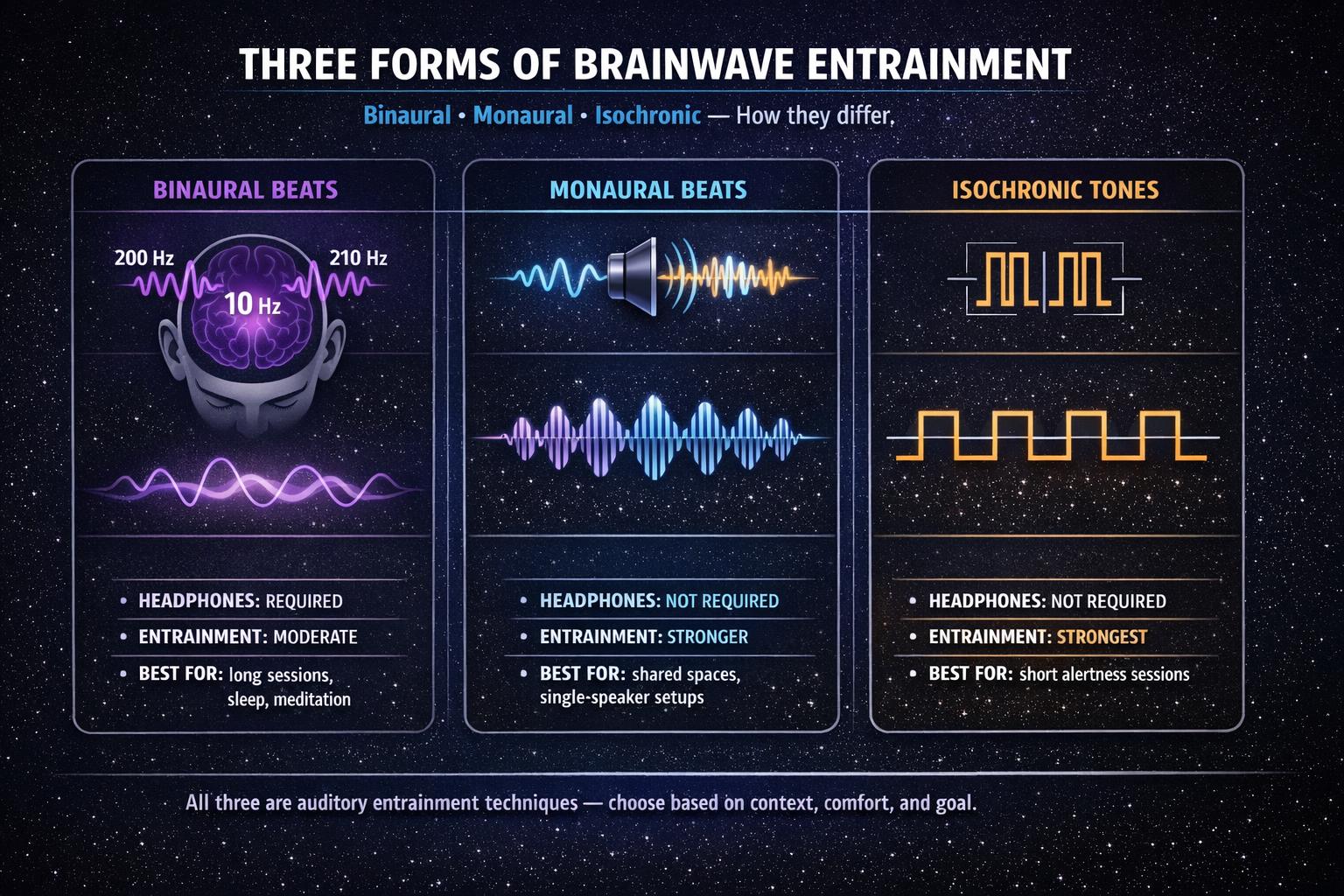
If you’ve spent any time on entrainment audio, you’ve run into all three: binaural beats, isochronic tones, and monaural beats. They get used somewhat interchangeably in casual writing, but the underlying mechanisms are different, and they’re not equally well-suited to the same goals.
The Three Mechanisms
Binaural beats are produced inside your brain. Two slightly different tones are played, one in each ear, and the brain perceives a third tone equal to the frequency difference. If your left ear hears 200 Hz and your right ear hears 210 Hz, you perceive a 10 Hz beat that doesn’t exist in the audio file. This perception happens in the superior olivary complex and is the reason headphones are mandatory.
Monaural beats are produced in the audio itself. Two tones at slightly different frequencies are summed before playback, so the beat exists in the waveform before it ever reaches your ears. You can hear monaural beats through a single speaker. The brain doesn’t have to do the work of generating the beat, it’s already there.
Isochronic tones are the most mechanically simple of the three. A single tone is switched rapidly on and off at the target frequency. There’s no second carrier and no perceptual addition, you’re literally hearing a tone that pulses at, say, 10 times per second.
A Side-by-Side Comparison
| Property | Binaural | Monaural | Isochronic |
|---|---|---|---|
| Headphones required | Yes | No | No |
| Audible “pulse” quality | Subtle | Noticeable | Pronounced |
| Generated in audio or brain | Brain | Audio | Audio |
| Entrainment strength | Moderate | Stronger | Strongest |
| Comfort for long sessions | High | Medium | Lower |
| Compatible with music backing | Excellent | Good | Limited |
| Best for sleep | Yes | Sometimes | No |
When Each One Shines
Reach for binaural beats when:
- You’re using headphones anyway (meditation, deep work, sleep)
- You want a subtle audio bed that doesn’t dominate your attention
- You’re stacking the audio with music, ambient sound, or nature recordings
- The session is long (30+ minutes) and audio fatigue matters
- You’re targeting a deep state (theta or delta) where comfort outweighs entrainment strength
Reach for monaural beats when:
- Headphones aren’t practical (a shared room, an exercise machine, walking outside)
- You want stronger entrainment than binaural but still some comfort
- You’re working from a single Bluetooth speaker or laptop
Reach for isochronic tones when:
- You want the strongest possible entrainment signal
- The session is short (5–15 minutes) and audio fatigue is less of a concern
- You’re targeting an alert state (beta or gamma) where a pulsing audio cue is welcome
- Headphone separation isn’t reliable (some Bluetooth setups disrupt true stereo)
What the Research Says
The three techniques haven’t been compared head-to-head as often as you’d hope, but a few useful threads exist:
- Isochronic tones tend to produce the largest EEG entrainment effects in head-to-head studies. The trade-off is the audio is harder to enjoy passively, so people use them for shorter durations.
- Binaural beats produce the most consistent subjective relaxation reports, even when their measured EEG effect is smaller than isochronic. The comfort matters: if you can’t tolerate the audio, you won’t use it long enough to get the benefit.
- Monaural beats sit in the middle on both metrics. They’re a reasonable default if you don’t have headphones but want more than ambient music.
A 2017 review by Chaieb and colleagues concluded that all three forms of auditory entrainment can produce measurable changes in cognitive state, with no single technique dominating across all outcome measures.
Common Mistakes
Using binaural beats without headphones. The beat is generated by the difference between left and right ear input. Playing the audio through a speaker means no binaural effect is produced, you’re just listening to two slightly detuned tones.
Using isochronic tones for sleep. The on-off pulsing is too stimulating for most people at bedtime, even when the target frequency is in the delta range.
Stacking all three at once. They don’t add up cleanly. Pick one mechanism per session.
Assuming louder is better. Entrainment strength plateaus at modest volume levels. Loud audio activates the orienting response and can pull you out of the target state.
A Practical Default
If you’re new to entrainment and not sure where to start, the safest defaults are:
- Binaural beats for any session with headphones (meditation, focus blocks, sleep)
- Isochronic tones for short alertness sessions when you want a strong, fast effect
- Monaural beats for everything in between when headphones aren’t an option
The differences matter less than consistency. The best entrainment technique is the one you’ll actually use four times a week for two months.